
Mapping Items to Learning Outcomes and Accreditation Requirements
Every year the same scene repeats in quality assurance units. The course report deadline approaches, a message goes out to departments asking for evidence of learning outcome attainment, and a familiar exercise begins: a spreadsheet, faculty members trying to recall which question measured which outcome on an exam written three months earlier, an approximate figure entered in the attainment column, and the report filed on time.
The problem is not anyone's diligence. The problem is that retrospective mapping is not measurement. When an item is assigned to an outcome after the exam has been scored and grades released, you are not documenting a measurement that happened — you are constructing an interpretive narrative around it. The difference between those two things is the difference between evidence that survives external review and a table that merely looks tidy.
The alternative is not more effort at the end of term. It is an architectural decision at the start: the relationship between outcome and item is established at the moment the item is authored, not at the moment the report is written. This article explains how that chain is built, how it translates into an assessment blueprint, how attainment is computed, and seven errors that invalidate the evidence even when the intent is sound.
Key Takeaways
- Retrospective mapping produces a report, not evidence. Alignment must happen at authoring time.
- The free-text field is the primary enemy of accreditation reporting: "encryption," "asymmetric encryption," and "cryptography" become three separate topics in the same report.
- Bloom's level and learning domain live on the outcome and are inherited by the item — never the reverse.
- The assessment blueprint is what turns alignment from a tag into a deliberate design of how marks are distributed.
- Learning domains in the Saudi framework have changed between editions, so the domain list must be configurable in the platform rather than hardcoded.
Why Manual Mapping Fails
Three failure patterns recur in every institution that relies on free-text entry:
Semantic scatter. When each instructor types the topic name by hand, the database ends up holding "Encryption," "encryption," "Asymmetric Encryption," and "Public-key cryptography" as four distinct entities. A report aggregating performance by topic will spread candidates across four rows instead of one, and every count will look small and uninformative.
Retrospective assignment. An author mapping an item to an outcome after scoring is inevitably influenced by the results already seen. This introduces a systematic bias: items candidates performed well on get assigned to the outcomes someone wants to show as attained.
Loss of traceability on edit. If an outcome's wording is revised mid-year without preserving the previous version, every report issued before the edit becomes uninterpretable. An external reviewer asking "what did this outcome say at the time the exam was administered?" will find no answer.
The Alignment Chain: Five Levels
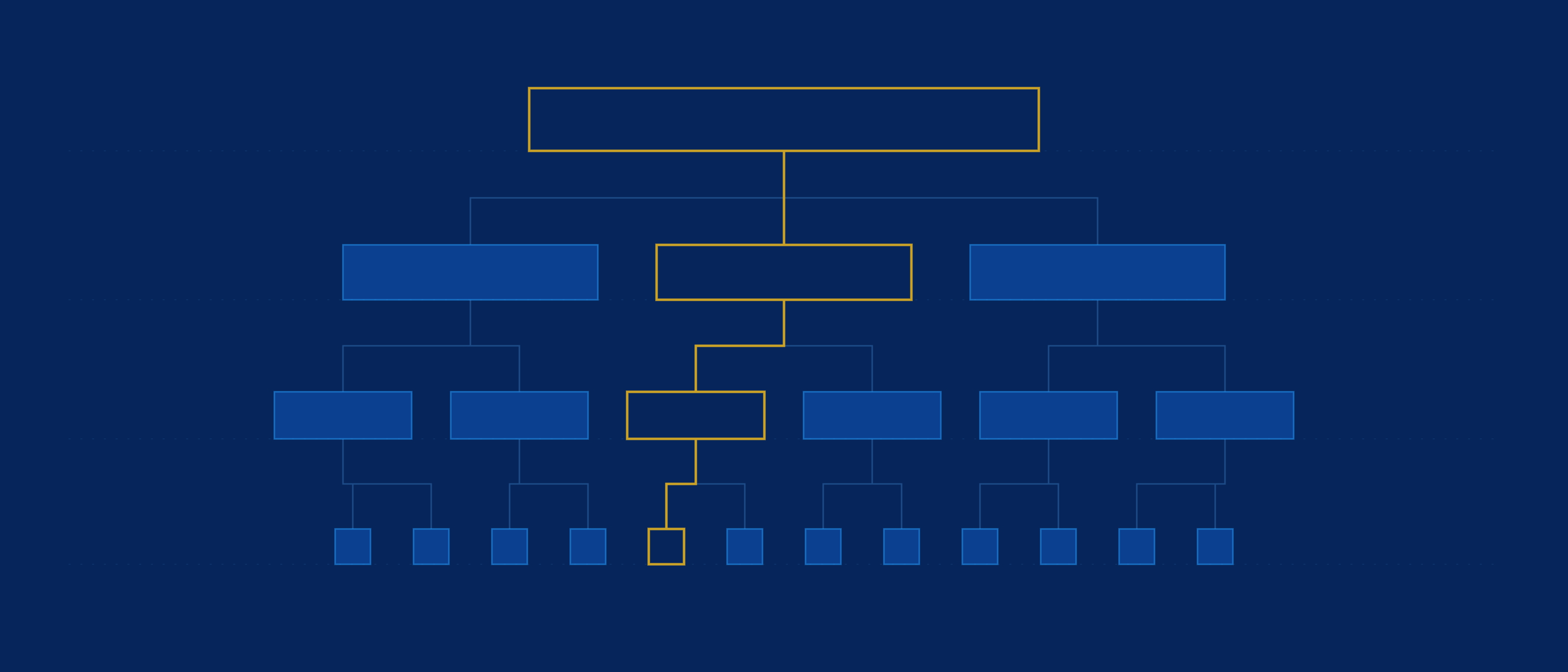
Sound alignment is an unbroken chain from program outcome down to the individual item:
1. Program learning outcome (PLO) — what the graduate can do at completion.
2. Course — contributes a defined share to one or more program outcomes.
3. Course learning outcome (CLO) — what the student can do on passing the course.
4. Topic or unit — the instructional organization the outcome sits within.
5. Item — the individual measurement instrument.
The governing rule: every item links to at least one learning outcome through a database relationship, not through text. The items table stores an outcome identifier (learning_objective_id) and never stores a topic name as a string.
The practical consequence of that single decision: the attainment report becomes a query that runs in seconds, rather than a two-week project at the end of term.
What Every Learning Outcome Must Carry
An outcome is not a descriptive sentence. It is a record with five mandatory fields:
- The statement — beginning with an observable, measurable behavioral verb. "The student knows the importance of encryption" fails, because knows cannot be observed. "The student generates a public and private key pair and explains the function of each" can be measured.
- Learning domain — a value from a defined list, never free text.
- Bloom's cognitive level — remember, understand, apply, analyze, evaluate, create.
- Link to a program outcome — which PLO this outcome serves.
- Associated assessment methods — exam, project, presentation, practical.
The second and third fields are specifically what make reporting possible, and they are defined once at the outcome level, then inherited automatically by every item linked to it.
Learning Domains in the Saudi Framework
The course specification templates currently in use are built on three learning domains:
- Knowledge and understanding
- Skills
- Values, autonomy, and responsibility
Earlier editions of the national qualifications framework used five domains (knowledge; cognitive skills; interpersonal skills and responsibility; communication, information technology, and numerical skills; and psychomotor skills), and specifications built on that model are still in circulation in some programs.
The direct design implication: do not hardcode the domain list. Make it a configurable table at the institution level, with versioning over time. A program that has migrated between framework editions needs to read its older reports under the older logic and its newer reports under the newer one — in the same system, without retroactive distortion.
Before building any item bank, confirm the edition currently adopted at your institution with the quality assurance unit, rather than relying on an older template circulating in a shared folder.
Why Bloom's Level Lives on the Outcome, Not the Item
This looks like an implementation detail. Its consequences are not.
When an author selects a Bloom's level manually on the item creation screen, three problems follow: selections diverge between two authors working on the same outcome; the level gets chosen arbitrarily under time pressure; and nothing guarantees that the item does not exceed the level of the outcome itself.
The alternative: the level is defined once when the outcome is created, and appears on the authoring screen as a read-only badge once the outcome is selected. The author sees what the item inherited and cannot alter it.
With one additional control rule: an item may not exceed the cognitive level of its outcome. If the outcome sits at "apply," an item demanding "create" is measuring something the course never promised to teach — a validity failure that no statistical indicator will reveal.
The Assessment Blueprint
Item-level alignment is necessary but not sufficient. The question at the exam level is: does the distribution of marks reflect the weight of each outcome in the course?
An example for a 40-mark final in a cybersecurity course:
| Outcome | Domain | Bloom's level | Items | Marks | Share |
|---|---|---|---|---|---|
| CLO1 | Knowledge and understanding | Understand | 6 | 10 | 25% |
| CLO2 | Skills | Apply | 8 | 14 | 35% |
| CLO3 | Skills | Analyze | 5 | 12 | 30% |
| CLO4 | Values and responsibility | Evaluate | 2 | 4 | 10% |
| Total | 21 | 40 | 100% |
This table is built before the items are written, not after. It immediately exposes faults that surface no other way: an outcome declared in the course specification but carrying no items at all, or a course claiming to develop analytical skill while 80% of its marks sit at the recall level.
Technically, the blueprint should exist in the platform as a constraint on test assembly — warning the author when the composition drifts from the target distribution — not as a separate Word document written afterwards.
From Marks to Attainment Evidence
After the exam, attainment is computed for each outcome. Two methods are common:
Method one — proportion of students above a threshold. A mastery threshold is set for the outcome (say 60% of the marks on its items) and a target proportion of students (say 80%). The outcome is attained if the number of students clearing the threshold meets or exceeds the target.
Method two — mean performance. The cohort's average percentage on the outcome's items is computed and compared against the target.
Both are legitimate, and the thresholds are set by the institution rather than the platform. What matters is that they are declared and applied consistently across courses, and that each report documents which method was used.
A worked figure for CLO2 in the table above: 156 of 200 students scored 60% or higher on that outcome's items, which is 78% against a target of 80%. The result: not attained, short by two percentage points — a gap that calls for a documented improvement action in the course report, not a shrug.
This is where the real value appears. The number alone is insufficient; it has to lead to an action. And the quality cycle only closes when that action is executed and its effect measured in the following cycle.
Seven Errors That Invalidate Accreditation Evidence
1. Too many outcomes. A course with fourteen outcomes produces outcomes measured by two items each — a sample too small to support a defensible judgment. A reasonable practice: four to six outcomes per course, with no fewer than four items each.
2. Linking an item to multiple outcomes without weights. If an item measures two outcomes, its marks must be split between them at declared proportions. Otherwise the full mark counts twice and attainment inflates on both sides.
3. Unmeasurable statements. The verbs know, understand, appreciate, grasp cannot be measured. Evidence built on them collapses at the first serious review.
4. Editing an active outcome without versioning. Any change to an outcome linked to live items must create a new version, with the previous version locked and still tied to the reports issued under it.
5. Relying on the final exam alone. The strongest evidence draws on multiple sources: exams, projects, practical assessment. An outcome in the values and responsibility domain is rarely measured convincingly by a multiple-choice item.
6. Confusing coverage with attainment. That material was taught and questions were asked about it does not mean the outcome was attained. Coverage is an input; attainment is an output; accreditation asks about the second.
7. A report with no action. An unattained outcome with no specific improvement action, named owner, and date turns from a development opportunity into an adverse finding.
What This Requires From the Platform
For alignment to become daily practice rather than an annual project, the system needs:
- A centralized curriculum structure with at least three levels (course → topic → outcome), managed from a single administrative screen.
- Cascading dropdowns on the authoring screen instead of free-text fields.
- Automatic inheritance of Bloom's level and learning domain from outcome to item, shown as read-only badges.
- A live blueprint that warns when test composition drifts from the target distribution.
- Outcome versioning that prevents a later edit from corrupting an earlier report.
- Exportable attainment reports in tabular formats, documenting the thresholds and method applied.
How EvaliX Addresses This
EvaliX is built around a centralized curriculum structure with three levels: course → topic → learning outcome. The learning domain and Bloom's level are defined once when the outcome is created, and every item linked to it inherits both. On the authoring screen there are no free-text fields for topic or cognitive classification — only cascading dropdowns and read-only badges confirming to the author what the item inherited.
The learning domain list is configurable per institution, so a program that has moved between framework editions retains a correct reading of both its older and newer reports. And any edit to an outcome linked to live items creates a new version while the previous one stays locked.
The result is that the attainment report becomes a natural byproduct of daily operation — exportable in a tabular format ready for the accreditation file — rather than a separate end-of-year project.
Request a demo to see the alignment chain and attainment report built on one of your own courses.
FAQs
How many items are needed per learning outcome?
There is no binding rule, but four items is the reasonable minimum for judging an outcome, and six to eight is better. Fewer than that makes attainment acutely sensitive to a single faulty item.
Can one item be linked to more than one outcome?
Technically yes; methodologically it is better avoided. If it is unavoidable, the item's marks must be split between the outcomes at declared weights rather than counted in full for each.
What if the institution changes its learning domain framework mid-accreditation-cycle?
Reports issued before the change remain valid under the logic applied at the time, provided the platform preserves versions of both outcomes and domains. This is precisely why the domain list must not be hardcoded, and why each report should document which framework edition it was produced under.